If you are a Microsoft reseller or IT provider, your co-op and MDF funding just got a significant overhaul. Microsoft's fiscal year 2027 started on July 1, and with it came the biggest reshaping of partner incentives in years. The rules around what activities are fundable, how claims are structured, and even who qualifies for funding have all shifted. Some of these changes are subtle. Others will directly affect your marketing budget if you do not act on them now.
This post breaks down the most important changes to Microsoft FY27 co-op and MDF so you can plan your spend strategically and avoid leaving money on the table.
Why Microsoft Is Steering Partners Hard Toward AI Demand Generation
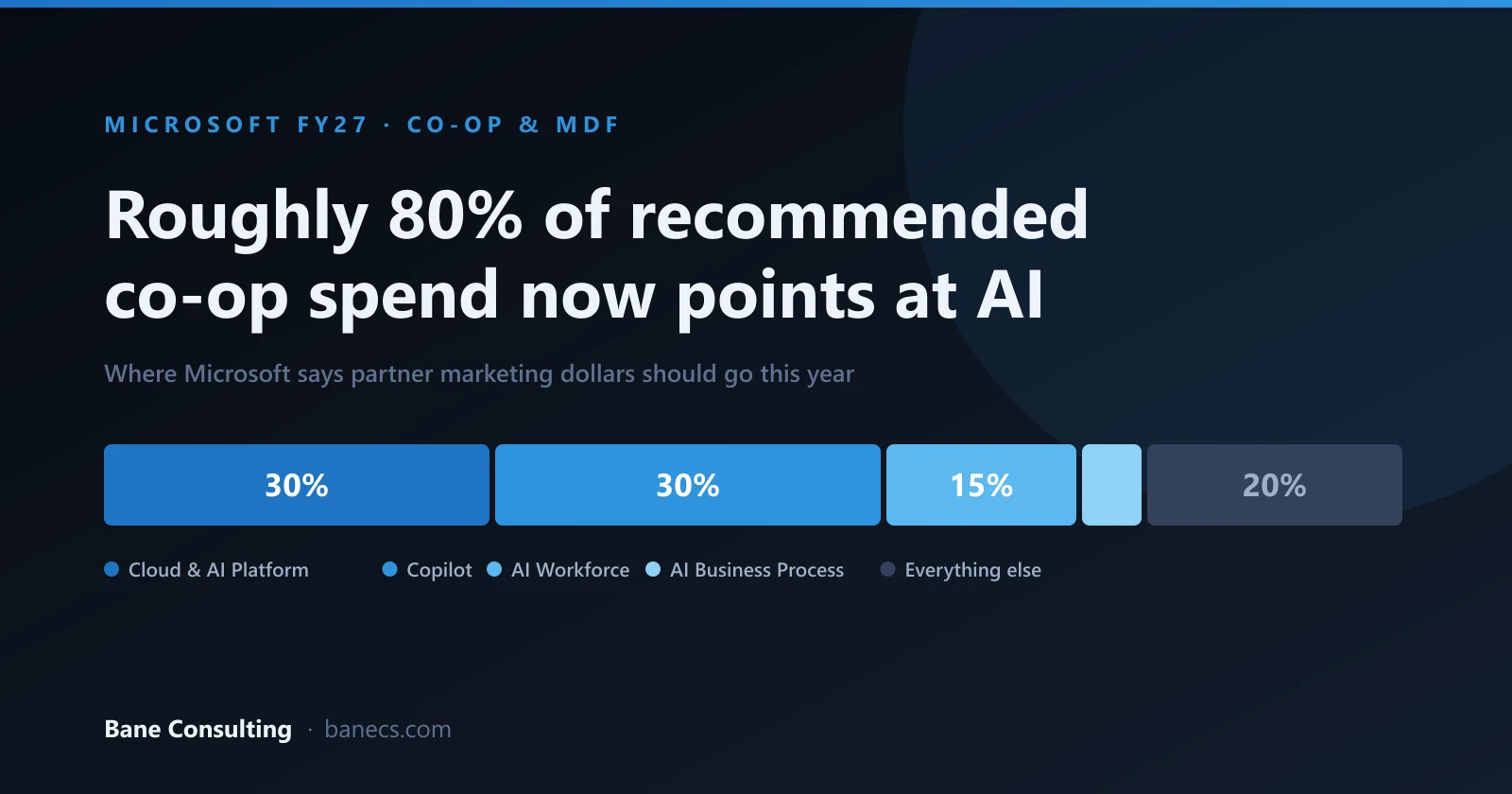
The biggest signal in the FY27 guidance is not a rule change, it is a spend recommendation. Microsoft has published explicit guidance on where partners should direct their co-op dollars, and the direction is unmistakable. Approximately 80% of recommended co-op spend points at AI-related activities, broken down as follows:
- 30% Cloud and AI Platform
- 30% Copilot
- 15% AI Workforce (excluding Copilot)
- 5% AI Business Process
That leaves everything else competing for the remaining 20%. If your marketing motion is still built around general awareness, broad IT services messaging, or product-agnostic campaigns, you are now swimming against the current of where Microsoft's investment is concentrated. The message is clear: Microsoft is moving its investment away from flat, run-rate volume and toward growth and premium products. Co-op spend guidance follows the same logic.
Paid Media With Multi-Touch Campaigns Is Now the Anchor Activity
This is the structural change that will have the most practical impact on how partners build their marketing plans. Microsoft consolidated what had previously been a range of separate FY26 tactics into a single activity called "Paid media with multi-touch campaign." Direct mail, email, social media, website activities, and search have all been folded into this one category.
The critical implication: you can no longer submit a standalone social media campaign or a website refresh as a fundable activity on its own. Paid media must serve as the anchor, with at least two supporting tactics alongside it. Single-channel marketing is no longer a valid claim under the FY27 rules.
Microsoft's own co-op ROI analysis, built on aggregated historical claims data, found that partners who invest in the highest-performing activity types realise 2 to 5 times higher future earnings from their Microsoft business than partners spending elsewhere. Paid media with multi-touch campaigns is the named example. So this is not just a compliance requirement. It is Microsoft pointing you toward what actually works.
Three Activities Were Removed From the Eligible List Entirely
FY27 eliminates three previously fundable activities:
- Microsoft Syndicated Content
- Proof of Concept
- Employee Purchase Web Setup
The removal of Syndicated Content is the most significant one for most partners. The practice of taking Microsoft's pre-built content assets and distributing them as your own marketing activity is no longer a fundable motion. If that approach has been part of your co-op strategy, it needs to be replaced with something that qualifies under the new framework before you submit your next claim.
How the Allocated Resource Cap Affects Your FY27 and FY28 Planning
For partners who have been using co-op funds to offset dedicated marketing headcount, the 50% allocated resource cap is holding steady for FY27. However, Microsoft has laid its intentions out clearly: this cap is expected to decrease in FY28, so partners should be planning now for that reduction. If half your co-op currently funds a dedicated marketing head, you have roughly a year to either build the case for that role standing on its own, or rebalance toward activities that will still be fundable.
There is also an important clarification worth noting. An allocated resource must be directly employed or contracted by you, and explicitly may not be a third-party subcontractor. Agency retainers do not qualify under that heading, though agency fees are eligible under plenty of the campaign activities.
Claim Rules Are Now Significantly More Specific
Beyond the activity changes, Microsoft has tightened the administrative requirements for how claims are submitted and supported. Partners need to be aware of the following:
- Third-party invoices must specify the activity, timing, and location of the work
- Claims require one line item per activity, with no bundling
- Travel is restricted, and meals and mileage are prohibited
- Sporting venues, hospitality, and entertainment-focused events are now restricted
One of the more notable announcements in FY27 is the restriction around event sponsorships and entertainment-focused costs. If your partner events have historically leaned on hospitality or entertainment as a draw, those components will need to be restructured to qualify for reimbursement going forward.
Deadlines Are Fixed and There Is No Grace Period
The claim and approval windows in FY27 are firm. Missing either deadline means forfeiting funds you have already earned.
- FY27-H1: Claims must be submitted by February 15, 2027, with POE approval required by March 31, 2027
- FY27-H2: Claims must be submitted by August 15, 2027, with POE approval required by September 30, 2027
Co-op is earned and accrued semi-annually, then spent in the following six-month window. That structure has not changed, but the stricter activity definitions mean that planning what you will spend and building the documentation to support it needs to happen well before the submission window opens, not in the final weeks.
Funding Eligibility Is Now Tied to Your Partner Capability Score
This is where the co-op and MDF changes intersect with something broader happening across the partner program. Access to co-op is linked to your Solutions Partner designation and Partner Capability Score (PCS). MDF access requires an active MAICPP membership combined with either a designation or a PCS of 25 or more points.
Points are checked monthly, looking at the current month and the previous five months. If the point total does not meet 25 points within that eligibility window, eligibility is lost until the 25-point threshold is reached again.
This connects directly to the certification and skilling changes that have been rolling out. Partner University closed on June 15, 2026, which disrupted established skilling paths for many partners. A gap in your certification status is not just a badging issue. If it pulls your PCS below threshold, it can pull your co-op and MDF eligibility with it. Monitoring your PCS monthly is no longer optional, it is a financial responsibility.
Co-op and MDF Are Not the Same Program
This is worth spelling out clearly because these two funding sources get conflated regularly, and conflating them leads to planning errors.
- MDF (Market Development Funds) is discretionary funding allocated by Microsoft ahead of revenue, typically for strategic initiatives. It requires an active MAICPP membership plus a Solutions Partner designation or a PCS of 25 or more points.
- Co-op accrues as a percentage of your earned revenue, with a minimum of $10,000 USD per six-month earning cycle. It splits across three categories: Demand Generation, Market Development, and Partner Skilling.
- Co-op cannot be used to match MDF contributions. The programs operate independently and cannot be co-mingled in that way.
Understanding how each program works, what it funds, and what its eligibility gates are is foundational to building a go-to-market plan that actually uses the money available to you.
What This Means for How You Plan Your FY27 Marketing
According to Omdia, 75% of partners under-invest in demand generation, and 43% of partners use less than half of their allocated vendor marketing investments. That pattern is costly in any year, but in FY27 it becomes especially expensive because the rules around what counts as a valid claim have narrowed considerably.
The partners who will get the most out of their FY27 co-op funds are the ones who start with the approved activity list, build multi-touch campaigns anchored in paid media, align their messaging to AI demand generation, and ensure their PCS stays above threshold throughout the year. FY27 investments, incentives, and specializations are being designed to reward partners who can prove capability, drive customer growth, and turn Copilot, agents, data, and security into repeatable transformation motions.
The funding is there. The question is whether your marketing strategy is structured to access it.
Related reading: Microsoft FY27 CSP incentive changes: what every Microsoft partner needs to know.